Showing posts with label imagination. Show all posts

Friday, February 1, 2008

Imagination Land

As I was reading about the mandatory imagination removal operation, I kept thinking about the problems facing an unimaginative civilization. Lacking an imagination cripples one’s creative thinking and problem solving skills. I think that a society without creative individuals is void of intellectual discoveries (scientific or otherwise) and therefore lacks any capacity for progress or adaptation. A society without progress is simply a machine for maintaining the status quo, and will eventually yield to the influence of outside forces. Even the wall will not protect the city indefinitely; it will inevitably decay and deteriorate.

As for motives behind the operation program, the Benefactor states that the people “longed for someone to tell them, once and for all, the meaning of happiness, and then to bind them to it with a chain.” (Zamyatin, 214) I can understand how he feels that the operation is a solution to the happiness problem; however, I doubt that the Benefactor intends to create a stagnant society. Surely one capable of orchestrating such a rational and efficient municipality must be able to predict the results of a complete lack of progress in a civilization. If progress is essential to survival, and if survival is one of the main goals of a society (other than happiness), than it seems that the imagination annihilation program instituted by the Benefactor is a step in the wrong direction.

I understand how the “operation” is useful and necessary simply as a plot device, but I find the character of the Benefactor to be intriguing, and I am curious as to the motives of the character as intended by Zamyatin. I noticed while reading that there is no mention of the guardians receiving the operation. I doubt that the efficiency of any police force would remain unaffected by removing the imaginations of the agents, and it would seem that the Office of the Guardians is more crucial than ever during the final uprising during the last chapters of the book. It could be said that the Benefactor is simply moving for complete control of society rather than focusing on eradicating unhappiness. His monologue during entry thirty-six is seemingly convincing of his dedication to the problem of happiness, but I am not decided.

Thoughts On Imagination, Souls, and Happiness

From page 90 in We:

A soul? A soul, you say? What the devil... I told you, we must cut out imagination. In everyone... Extirpate imagination. Nothing but surgery, nothing but surgery will do...


1) So imagination, in the eyes of the One State, is a sickness. Why?

In class, the idea came up that imagination could be considered "bad" because it provides the possibility of always imagining that things could be better. Imagination could promote ongoing unhappiness or discontent.
But it seems that by the same reasoning, imagination provides the possibility of always imagining that things could be worse. So imagination could also promote ongoing happiness or content.
It is exactly this variability and uncertainty that makes imagination "bad" in the mind of the One State. It is the dreaded X. It allows for creativity. But why is this bad?
Try to imagine a computer that had creativity or imagination. How efficient would it be? You tell it to calculate something and it thinks for a second, then asks "Why?". A computer that has the ability to step outside of the realm of code is not very efficient or useful. Maybe this is why the One State fears the "soul". Like computers act only according to their logic commands and code, the One State citizens without souls act only according to their logic and reasoning. They fear that if all of the citizens start developing these souls, the "wonderful" order and efficiency that the One State holds dear will be ruined. The citizens will be rendered useless.

2) Is the One State really achieving happiness for its citizens?

In order for "Good" to exist, "Evil" must exist. In order for darkness to exist, light must exist. The same seems true for happiness. If unhappiness is not a possibility, how could happiness be one? The One State citizens can't be happy. They are feeling something else. Safety maybe. Their lives, like those of computers, are decided for them. They are safe from error.

Tuesday, January 29, 2008

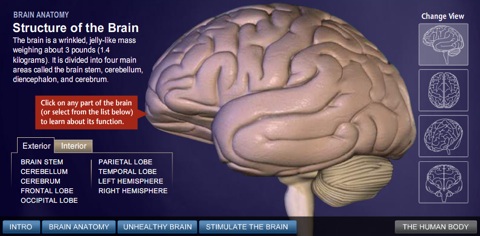
National Geographic brain widget

national geographic brain guide screenshot
If you want to know what part of D-503’s brain is the seat of his imagination (and is in danger of being cut out) and other interesting grey-matter facts, check out National Geographic’s nifty interactive brain guide.

via Boing Boing