I was thinking more about the portrayal of mathematicians in literature as we have discussed it this semester. I was thinking back to our original attempts to define what constituted literature. At first, we tended to include almost anything, like text books or magazines. But if I recall correctly, we finally decided that literature generally had topics of "substance" and had a lot of "depth" to it, and was perhaps concerned with "asking thoughtful questions". So Dostoevsky writes literature but J.K. Rowling does not (I know, harsh). Given this context, it might not be surprising that the mathematicians in literature would tend to be the crazy ones. For instance, We is certainly a book of substance seeking to discuss some deep questions, and is thus literature. D-503 is basically a tool for discussing these questions. But the questions being asked require D-503 to behave in these extreme ways so that the novel can illustrate its points about happiness etc. In other words, it is not just a book about mathematicians, and thus is not very focused on portraying them in a realistic manner, since that would not serve to address the questions the novel is trying to ask. Since most literature has this type of depth it wants to cover, it's not surprising that if the protagonist is a mathematician, he would not be a typical one but rather a very "deep" and extreme example of one.
Wednesday, April 30, 2008


Tuesday, April 8, 2008
Waking Life
There is a film that was made in 2001 called Waking Life. It is directed by Richard Linklater and most of the film is shot in Austin. It is about a young man who is searching for purpose and meaning. He has many philosophical discussions throughout the film. In fact, many of the people that are discussing in the film are professors here at UT. For those of you who enjoy thinking deeply about important questions, I highly recommend this film. I hope you enjoy these clips from it.
In the following scene, one of our professors here at UT discusses free will and determinism. This is something that has come up quite a bit in our class, especially in Vas. I strongly agree with the last few statements he makes.
This next scene talks about language.
When you watch this scene think about D-503 and the rest of the One State. The One State is just a sophisticated ant colony.
Tuesday, April 1, 2008
Thoughts on Pi (not the number... I don't want to have a stroke or go insane)
Max is obsessed with figuring out what the 216 digit number's significance is. Towards the end, we find out that Max's obsession was not driven by materialistic or spiritual reasons. If he was driven by materialistic reasons, then he would have gladly cooperated with the Wall Street people and would have exploited the stock market for money. If he was driven by spiritual reasons, then he would have cooperated with the Jews. So what was he driven by? A strong passion for problem solving and pattern searching? His insanity? It is sort of the chicken and the egg thing... which came first: his insanity or his obsession with the number?
I tend to think that the conversation that Max has with Sol earlier in the film was Sol trying to protect Max from going down a similar road that he had. I think Sol says "you can find patterns anywhere if you are looking for them" in order to convince Max that this 216 digit number is nothing. But we see by Sol's second stroke and consequent death that Sol didn't really believe that this number is insignificant. In fact Sol himself had some sort of obsession with the number. All of this makes me think that it is the math that is making the madness, not the madness making the math.
I still don't know what to make of the ending. Maybe it is a happy ending because the madness had left. Similar to D-503 in We, Max has rid himself of the sickness but has also sacrificed his chance to find purpose and meaning. Then again, maybe none of that really happened.
Sunday, March 30, 2008
Faith in Numbers
In both Pi and We we have two protagonists who live their lives based on the logic and rationality of numbers. Yet in the both stories the characters both have faith in some unquantifiable quality that governs the world (and the universe).
In We, D-503 has unquestionable faith in the benevolent Benefactor and the
In Pi, Max has faith in patterns. Everything in the universe has some pattern. In his blind faith in his belief he discounts ideas of any sort of spontaneity or randomness. How can someone with such a high ability to rationalize things believe that there are no anamolies in existence? On the other hand, perhaps he is right.
To me it seems that both concepts lead to the idea of whether or not people have free will or not, a universal question that no one seems to have the answer to. If life is We and everything is ran by a system and order then people no longer become people but simply parts of a machine. Machine parts have no choice in their functions. If life is Pi then people have no free will but are simply enacting the patterns upon patterns set in motion at the beginning of time. Every person born, grow, wilt, die, born, grow, wilt, die – forever until the pattern ends.
Friday, March 28, 2008
Max and D-503
When watching Pi in class, I noticed a few interesting parallels between D-503 from We and Max from the film. Both characters are troubled by irrationality and disorder. D-503 is agitated by even the thought of imaginary numbers, namely the square root of negative one. Max is adamant that patterns lie behind absolutely everything. His faith in this concept is so strong that he drives himself crazy working to discover underlying patterns in things that appear rather random. Neither character believes in a God by our popular definition. D-503 does believe in the Benefactor who Zamyatin depicts as a God-like figure to the One State, however, little faith is required in this belief. The Benefactor is a tangible person whom the One Staters see on Election Day. D-503 does not believe in a God beyond his society, and this sort of faith would be difficult for him as God is much more enigmatic than his dreaded square root of negative one. Max was raised Jewish but no longer practices any faith. His agnosticism seems possibly counterintuitive since he is constantly looking for patterns and believes everything is controlled by something greater, specifically mathematics. Both characters are mathematicians who are removed from society by their individual obsessions, Max’s being patterns and D-503’s being the world beyond the Green Wall.
Monday, February 4, 2008
D's Ending
First of all, I'm sorry this blog is so late, but I figured I might as well post my blog anyway (for Learning Record purposes).
I really believe that D503 didn't want to be saved. He didn't want to leave his perfect little world in the One State and experience the harsh reality of life outside this bubble. Here are a couple of entries from We which support my theory.
- page 185 last paragraph: "I walked alone through the twilit street. The wind was whirling, driving, carrying me like a slip of paper. Fragments of cast-iron sky flew and flew-they had another day, two days to hurtle through infinity...The unifs of passersby brushed against me, but I walked alone. I saw it clearly: everyone was saved, but there was no salvation for me. I did not want salvation..."
- page 197 3rd/4th paragraph, which includes the story of the "Three Excused Ones." "It is a story of how three numbers were, by way of an experiment, excused from work for a month: do what you like, go where you wish. The wretches loitered near their usual places of work...they stood in the street hour after hour, repeating the motions which had already become necessary to their organisms at the given times of day...And finally, on the tenth day, unable to endure it any longer, they linked hands, walked into the water, and to the sounds of the March, went deeper and deeper, until the water put an end to their misery..."
In the first entry, D clearly states that he does not want to be saved. I think the idea of having a soul and being with I was tempting and sounded appealing to D, but I don't think he was strong enough to actually make it happen. I don't think he had enough courage, experience, or wisdom to live his own life and make his own decisions. None of the numbers seem like they have very much confidence in themselves; they depend on the One State and the Benefactor to tell them what to do and how to live their lives.
In the second entry, I think the story of the "Three Excused Ones" is a perfect example of what these people would do when given freedom. They will continue to do what they are familiar with, what they have been programmed to do. I suppose this story might have been fabricated by the Benefactor himself to frighten the numbers, but I wouldn't at all be surprised if the story is based on true events. If D really wanted to be free, he could have easily left through the tunnels, but he was too afraid of leading his own life.
When I encountered these entries during my reading, they seemed very ominous. I was very skeptical of the idea that D would actually go through with I's plan. I can understand why I330 kept testing his loyalty throughout the book. D's heart was in the right place, but he was brainwashed beyond salvation.
Saturday, February 2, 2008
Happiness is an emotion
 hap pi·ness n. - state of well-being characterized by emotions ranging from contentment to intense joy
Look at these pictures. Would you say that these pictures depict the emotion happiness? To me happiness involves a smile, a laugh, and bright open eyes. I would say that these pictures are a good representation of happiness.
Not once in my reading of We did I get the sense that anyone was experiencing the emotion of happiness.  Some may say that D-503 was happy when he was obsessively chasing I-330 around. He was definitely feeling the emotions of lust, but I don’t think he was feeling happy. Ana spoke of happiness in her latest blog post. She stated that “The numbers don't know love, or hate, or envy or anything resembling emotion, so how can they know happiness? The numbers are not allowed to experience emotions, so they cannot experience happiness. Happiness is an emotion.
The One State, dominated by rational thought, frowned upon emotions. D-503 was diagnosed with having a “soul” because he was experiencing his emotions. Emotions threatened the Once State and that is why everyone had to get lobotomies.  In a lobotomy the frontal lobes are removed. It is believed that this is the part of the brain where creation of emotions is believed to take place. So obviously the One State did not want the inhabitants to experience the emotion called happiness.
Friday, February 1, 2008
Don't Worry, Be Happy
The more and more I think about We, the more I seem to think about something that I've yet to talk about in class. Happiness is portrayed as the ultimate goal of the One State's quest throughout the novel. However, whenever I think about the way the inhabitants are treated I can't help but believe that there are ulterior motives that underly the entire operation. It is known that the Integral is being built so that the One State can venture into the unknown depths of space in hopes of spreading their ideals to others but I think that a sense of megalomania might exist within the Benefactor.
The fact that the Benefactor has controlled a 'utopia' with such great precision might have caused him to lose sight of the original goal of the One State. Also, the uncertainty of who the Great Operation was performed on really makes me ponder this theory. Why did we never know if the Guardians had the procedure performed on them? What about the Benefactor? It really seems like the citizens in the One State are merely pawns in a much larger scale operation than they are aware of.
Does power equate to happiness for the Benefactor? Is there some greater cause that the One State is trying to achieve? You decide!
Biblical Allusions in We
I know we talked about this in class on Thursday, but today I want to write a little more about Zamyatin’s use of religion, particularly biblical allusions in We. I think the beginning of this novel can be seen as a story of Adam and Eve. At first, we are told that the One State is set up to be perfection on Earth, just like the Garden of Eden. With the Benefactor as God, he created a society intended to promote happiness and comfort free of pain, envy and worry. At some point before we met her, I-330, as Eve, was introduced to the “forbidden fruits” of the ancient world. These are the things that the One State wanted to keep from the numbers such as alcohol, lust and appreciation of ancient music. Just as Adam and Eve, I-330 shared her forbidden knowledge with D-503. In the Bible, it is understood that this was intended to happen as part of God’s plan for humanity. I believe this idea of Adam’s predestination is paralleled by D-503. D discovers that his mother was from beyond the Green Wall so perhaps he was predisposed to have a “soul.” The social hierarchy in We also emulates a divine hierarchy. The Guardians are in place to keep the numbers from straying from the way of the One State and to serve as liaisons between the Benefactor and the masses. This concept is similar to the idea of guardian angels. I wonder why Zamyatin chooses to illustrate his dystopia as a parallel to a Christian society. Is he mimicking faith? Is he simply creating a society we can understand, by introducing the One State just as the Earth is introduced in the Bible? Or is the One State a satirical criticism of impending communism in his own country?
Tragic Ending
While reading the book, the whole time, I just knew the story was going to end badly. The actual ending was not near as bad as I was expecting. I thought for sure D-503 was going to die, most likely under the Benefactor's Machine from all of his excapades. The story built up and up and then kind of gently ended in an unexpected way. D-503 finally begins to understand his "soul" and feel emotions, fear, jelousy, rage and see the flaws of the One State. Just as he seems to see life and the world in a different way, a way that is more clear to him with "no infinity," the operation is forced on him. After the operation D appears to be very happy, very submissive, and seems to be the ideal citizen he thought he was towards the beginning of the book. This hardly seems to be the tragic ending I expected out of this book. On the other hand though, seeing the changes D has made, especially from his point of view, definately caused his zombie-like transformation from the operation to seem tragic. And it was hard not to feel bad for I-330 as she was tortured by the benefactor to find out more about the enimies of happiness while D-503, or at least his body, sat there and watched with no reaction to what was going on. I pictured it as seeing a dead person; the body is familiar, but it is no longer the person you know. Overall, the ending was unexpected, and definatley is considered tragic in my eyes.
The Undenieable "I"
After pretty much finishing this book i thought of something very interesting. I think that D-503 had the capability of change and grow a soul all along. What got me most interested in this was the number of "I"s used. This peaked my interest because of the other literature mentioned in the book: Daily Odes to the Benefactor, Red Flowers of Court Sentences, and Stanzas in Sexual Hygiene. None of those books seem to have any reference to the personal feelings or doings of their authors. D-503's journal has almost all to do with that, which I didn't really notice until about the twelfth entry; it starts with " I have the constant feeling: I will recover, I can recover." After reading this I decided to go back through all the entries and just look for "I"s. In a society like the One State there should be no "I." D-503 makes a similar comment when he speaks of O wanting a baby of her own, or having D be hers. "My" and "mine" don't exist in the One State so why should "I." Here I think back to the borg who had a similar society. Once a being was assimilated it lost its lone identity and became one of them. In the Star Trek movie they are defeated when the assimilated remember their lone identities and fight back. D-503 has his lone identity from the very beginning. The very first words of the book are "I shall simply copy,...". He does not say "here are the words from this book" or " our beliefs lie in this" or even " the great benefactor has taught us"; D-503 introduces himself as a lone identity, an important identity. This should show us that from the very beginning D-503 is different from the rest of the "normal society" and that he has something or is capable of something that others are not. The run in with I-330 didn't cause D-503 to grow his soul or question his society, it just sped up the process. Left by himself D-503 would have started questioning things, eventually, but maybe in a bit of a different way. but that is just what i think.
Tuesday, January 29, 2008
National Geographic brain widget
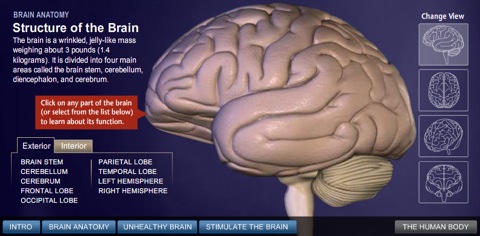
If you want to know what part of D-503’s brain is the seat of his imagination (and is in danger of being cut out) and other interesting grey-matter facts, check out National Geographic’s nifty interactive brain guide.
via Boing Boing
Friday, January 25, 2008
D-503 is HOT
D-503 is hot. I admit it. I have a thing for nerds. Some girls like a man who can speak French in their ear, but give me a man who can ramble off the first 50 digits of Pi. There’s nothing like a guy who can tell me the explanation for Fermat’s last theorem or who can justify his conjectures on the Sierpinski problem. I bet D-503 could do all these things and this makes D-503 hot.
D-503 is cute too. I don’t really know what he looks like but I think he is pretty adorable. I love how he is so vulnerable with us, sharing his life and his thoughts with us. Poor guy. He’s all torn up these days, struggling with his identity, struggling with “X”, struggling with his “soul.”
I know I’m being a little silly by saying that D-503 is cute and hot. I guess I was just trying to get your attention or maybe it was a way to be creative or something. I don’t know about you, but I can relate to D-503 and his struggle. It may be hard for us to see because we are inside of it, but we too live in a “One State.” This may sound a little extreme or kind of wacky, but I think our society forces us to think and be a certain way. I struggle with who I know myself to be and who society thinks I should be. I’m sure you struggle too.
Pi is Exactly Three!

The environment that is established in the One State is one of absolute certainty. Every aspect of every day, minus the Personal Hours, is meticulously orchestrated to provide for maximum efficiency and fluidity. The collective good outweighs the rights of the citizens to such an extent that those who are deemed as a threat to society are eliminated. Knowing this, it seems as if D-503 is slowly but surely becoming a threat to the entity that is the One State. He "[can no longer fulfill his obligations to the One State]" because of his confused state of being, which can be directly linked to his relationship with I-330 (58). D-503's transformation from a state of self-assurance to one of utter denial illustrates the conflict that he has between his old self and new self. On one hand, he has always been a model citizen who has lived to serve the One State. However, his newfound 'soul' has lead to him to become rather uncertain in a 'world' of absolutes. The emergence of S, who "[follows D-503 everyday like a shadow]" also raises suspicion as to what is to come (86). The fact that D-503 is being monitored and that he is beginning to show signs of noncompliance and individuality makes me wonder what significant events are on the horizon. What will D-503 choose to believe and what will the end result of that decision be? Will he be like Professor Fink from The Simpsons and challenge the realm of mathematical absolutes? Only time will tell. Glayvin!
Pink vs. Yellow
Throughout We, D503 describes different characters and objects as being a specific color, namely pink and yellow. In this novel, D believes there is an obvious conflict between the orderly and the chaotic. These two colors seem to illustrate how D feels about the observation.
The dawn sky is “rosy.” O-90 possesses “pink lips,” a “pink mouth,” a “circle of rosy arms,” and “pink attention.” D also describes her as “pink with pleasure.” At first meeting, S is depicted as having “pink wing-ears.” Even I-330 has her pink moments. In the Ancient House, D describes I’s breasts as “glowing pink.” D is pleased by all of these things. At the time, he is not made nervous by S’s presence, and though he finds I-330 annoying and questionably defiant, she still has some redeeming “pink” qualities. All of these observations relate to orderly qualities accepted by the One State.
In contrast, I-330, the Ancient House and the Green Wall bring about a lot of yellow images that make D uncomfortable. I’s “saffron-yellow dress,” is the first. Once D acknowledges that he is “ill,” he asserts that “all the days are one color-yellow,” a “parched” and “fiery” color. He sees a beast through the green wall with “yellow eyes.” Even the fence of the Ancient House is made up of “yellow teeth of ruined walls.” To us, yellow generally implies happiness and sunshine, but D sees the color and imperfect, perhaps the color of fire and anger or simply a discolored version of pure white.
O and D vs the One State
I find it interesting that O-90 and D-503 are both beginning to stray farther and farther from the society of One State. They both seem to, even though it is harder to see O's perspective, value the One State and want to be ideal members. It seems to me that emotional connections, or sexual connections, have an impact on how these two citizens of the One State move away from the beaten path. I-330 has a lot to do with D's regression while D has a lot to do with O's. O's connection with D has caused her to want to have a baby with D against the One States laws.
"But I want, I must have your child-give me a child and I will go..." (p. 112)The fact that she knows D does not see her the way she sees him makes her want the baby to feel close to him. You get a sense of O's feelings for D when R says, "With me, it is nothing, you know, merely a pink coupon, but with you..." (p.62)
Now, the way I has made D develop a soul, and caused him to break many of the One State laws, I think, is much more apparent, and there are examples throughout the book so far. I am not going to bother with siting any of them. It seems though, that O and D are both going down a path where one or both of them could be struck down by the mighty hand of the great Benefactor.
Freedom is Un-freedom
What exactly is freedom? Is it something that is inherently human, or is it something that we are taught? In WE freedom is frowned upon. D-503 talks about how he despises the “free time” in the daily schedule. He can’t wait for the day when every one of the 86400 seconds of a day are scheduled. Now, does “freedom” of D-503 mean the same thing as “freedom” does for us, of course not. D sees “freedom” as chaos. D sees freedom as the worst thing in the world. D strives for the ultimate “unfreedom”, the ultimate rationality. At first this seems like a bit crazy. Then I got thinking would it really be. If one wanted to insure freedom of people to do anything they wanted and insure freedom of life then an intense amount of government overview would be necessary. This makes sense and this close control of the government is exactly what the guardians do in WE. So the more freedom one wanted in this “perfect” society, the more government control would be necessary. This constant escalation of freedom would eventually lead to WE’s unfreedom. A time when the power of the government is so great that they could tell the people what freedom is, what freedom they wanted, and that freedom is not freedom at all ( in the book’s case at least). So at what point does freedom become chaos and mathematical rationality become the perfection of society? When does a free choice become a demanded choice? I hope the book tells a bit more of the One State’s history so it can possibly deal with some of these questions.
The Ascendancy of Man in We: Humanity's Quest for Control
History clearly displays humanity's persistent quest for control. From Adolf Hitler to Saddam Hussein, there are seemingly endless examples of leaders exploiting their power to control the people they lead and others. This quest can be observed on a macro level also by looking at the way man has pursued mathematical and scientific knowledge throughout history. These fields give man a sense of control over nature.
Why does man want control over his surroundings so badly? The things that he can control can't harm him. It is this fact that explains why the things that humans fear most are the things they have no control over: death, the unknown, tornadoes...
In We, this theme is by no means subtle. The One State is organized and governed for the most part by mathematical principles. In this society, man has "channeled all elemental forces--there can be no catastrophes"(23). All citizens live in glass houses. There are "Guardians" to keep watch on the happenings; they are to keep order. There is even a space ship (the Integral) being built for the purpose of integrating inhabitants of other planets into the controlled ways of the One Sate.
The citizens feel safe in the One State because everything around them is controlled. Although it is not controlled by them personally, it is controlled by an entity that they feel to be one with. It is apparent that D-503 values safety when he explains that "when man's freedom equals zero, he commits no crimes"(35). Protection from crimes is well worth giving up personal freedoms in D's mind. In fact, control and safety are so important to D that he can't stand the thought of i, the square root of -1. This is because it was "foreign, alien, terrifying. It devoured [him]--it was impossible to conceive, to render harmless, because it was outside the ratio"(39).
It is a sense of control, a feeling of safety, that sustains the "happiness" of the One State citizens. But it is only a matter of time before they realize that "[o]nly the unsubduable can be loved"(72).
Thursday, January 24, 2008
Individual vs Society
Our conflict was between the individual and society.
Curious, most curious...of course, unless you have some special reasons to...(page 90)
"Listen," I said. "You know that everyone who poisons himself with nicotine is ruthlessly destroyed...quick destruction of a few is more sensible than giving many the opportunity to ruin themselves. (Page 55)The belief of everyone in the one state is that the interests of the society should come before the interests of the individual. D-503 begins to be conflicted as the development of his soul leads him to think more about his individual welfare. ...and class is over.
Ideas of conflict as seen in We
From this last reading we found many types of conflict! The main conflicts we found were
D-503 vs. 0-90: as seen in the 18 & 19th entries; How they feel different about each other with D-503 being very rude!
D-503 vs. Himself: as seen in the 17th entry; There are many times in the story where he constantly contradicts himslef.
I-330 vs. One State: 10th entry; I-330 was rebeloling against the One State by drinking and smoking.
D-503 vs. O-90 & R-13: 8th entry; D-503 is starting to look alienated from there little triangle of sort!